There are few ideas in cooking that have shaped professional kitchens as profoundly as the concept of the mother sauces. Yet in most modern kitchens, you will rarely see them cooked in their classical, uninterrupted form.
Chefs are not standing over pans of béchamel every day. Espagnole is not being prepared in its original, labour-intensive structure in most contemporary restaurants. Even velouté, hollandaise and tomato-based sauces are often expressed in far more simplified or modernised ways than they once were.
And yet, despite this, the idea of the mother sauces remains absolutely fundamental. Not because chefs are constantly making them. But because everything still comes from them.
As I’ve mentioned countless times, before codification, cooking was largely regional and inconsistent. Techniques existed, but they were passed from kitchen to kitchen without structure. Sauces varied from household to household, and there was little standardisation in how flavour was built.
What French cuisine did was change that.
It did not simply create recipes.
It created a system for understanding sauce itself.
The beginnings of this structure are often attributed to Marie-Antoine Carême, who began the process of organising French cuisine into a more formalised discipline. At a time when cooking was still largely intuitive, he started to define categories, structure and hierarchy within the kitchen.
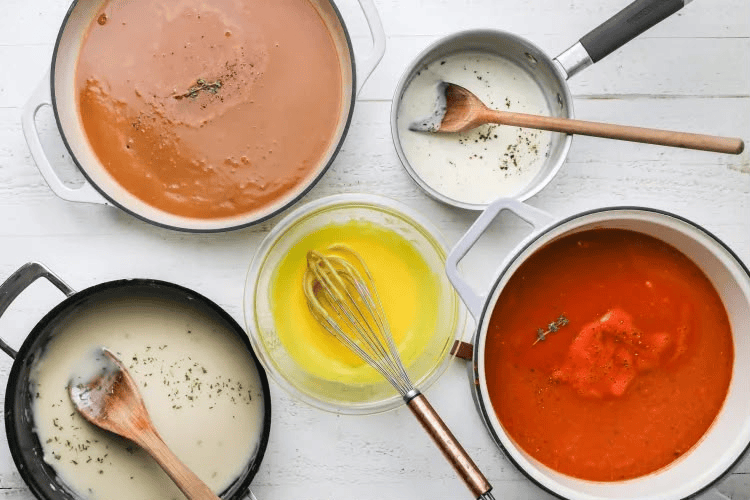
But it was Auguste Escoffier who refined and simplified this thinking into what we now recognise as the five mother sauces:
- Béchamel
- Velouté
- Espagnole
- Hollandaise
- Tomato
At first glance, they appear simple. Five sauces. Five foundations.
But their importance was never in their simplicity. It was in what they represented.
Each mother sauce became the starting point for an entire family of derivative sauces. From béchamel alone, you can build sauces that feel entirely distinct in character. Velouté becomes the base for lighter, more delicate sauces. Espagnole transforms into rich, deeply reduced, savoury accompaniments. Hollandaise introduces emulsion, fat and acidity in perfect balance. Tomato, the most familiar of all, anchors itself in both rustic and refined cooking.
Together, they form a language.
A way of thinking about how flavour is constructed rather than just how it is finished.This is where their real significance lies.
Most chefs today are not cooking these sauces in their original, formalised state on a daily basis. Modern kitchens move too quickly. Menus evolve too frequently. Techniques have become more direct, more efficient, more expressive.
But the foundations remain.
Even when a chef is not making a classical velouté, they are still building on its principles. Even when béarnaise is replaced with a more modern interpretation of acidity and fat, the underlying logic is the same.
Warm emulsion.
Reduction.
Balance.
Structure.
These ideas have not disappeared.
They have simply been absorbed into the way chefs cook without always being named.
The true power of the mother sauces is not that they are used constantly in their purest form. It is that they taught generations of cooks how to think.
How to build flavour in layers rather than moments. How to understand that a sauce is not just something added at the end of a dish, but something that defines its structure from the beginning.
It is easy to forget how radical this idea once was. Before this system existed, sauces were inconsistent, often improvised, and rarely repeatable across kitchens. What Escoffier achieved was not just culinary organisation, but clarity. A shared foundation that allowed cooks to communicate through technique rather than guesswork.
And even now, in kitchens that would not describe themselves as classical in any sense, that language remains.
You can see it in reductions that begin as stocks. In emulsions built from scratch rather than shortcuts. In the quiet expectation that a cook understands not just how a sauce tastes, but how it is constructed. That is the legacy of the mother sauces.
Not rigidity.
Not tradition for its own sake.
But understanding.
And perhaps that is why they endure.
Because while modern cooking continues to evolve, the need to understand where flavour comes from has not changed.
Chefs may not cook the mother sauces every day. But they still cook in a world they created.
Tom
Chef & Owner, Bohémien

