It’s something I get asked a lot.
“How do you come up with your dishes?”
The honest answer is that every chef does it differently. There’s no single correct way & no set system you have to follow. Some start with ingredients, some with techniques, some with an idea they’ve seen somewhere else.
None of them are wrong.
What has changed, though, is how easy it is to access information.
You can learn almost anything now on the internet. Recipes, techniques & full dishes all online, often demonstrated step by step by some of the best chefs in the world.
That’s a brilliant thing. It makes learning more accessible than it’s ever been. But it’s also a bit of a double-edged sword. Nearly every video of a dish I put up on social media draws the same message or comment from some cook, somewhere in the world…. “Recipe???”
I remember working with a chef who showed me a dish he’d “come up with”. It was well thought out, nicely put together but it was also, word for word, exactly the same as a dish I’d seen a two Michelin-starred chef demonstrate on YouTube.
Learning from others is essential. Copying, at least for a while, is part of how you improve. But at some point, you have to take that information and turn it into something of your own. And for me, that’s kind of the whole point.
There’s also the influence of the kitchens you work in.
Whether you realise it or not, you take something from every place you work in. That’s kind of the whole point of working in good kitchens in the first place.
You pick up ways of doing things, combinations, standards, habits, sometimes consciously, sometimes without even noticing.
A technique here, a way of plating there, how someone builds a sauce, how they season, how they think about a dish. It all adds up over time. Early on, a lot of what you cook is shaped by that.
It’s not really “your” food yet and that’s fine. It’s not supposed to be.
You’re learning, absorbing, building a foundation. Over time, that starts to shift.
You begin to filter things. Keep what makes sense to you, drop what doesn’t and slowly something more personal starts to form. That takes years and even then, it’s not fixed.
I’ve seen things in kitchens that have genuinely blown my mind, techniques where I’ve just stood there dumbfounded. Tasted ingredients I’d never heard of from places I didn’t know exist. Watched my head chef intently doing everything from chopping chives to how he sautéed a piece of meat & be really inspired. On the flip side I’ve also seen some things I’d never repeat, been asked to prepare foods in ways I would never choose too today.
I think this is the same for every chef but the point is always to build your own ideas from these experiences.
If I look back at the food we were serving at our first Bohémien dinners, it feels completely different to what we’re doing now. Almost unrecognisable, if I’m honest.
Not necessarily worse, just… earlier. And that’s how it should be.
If your food isn’t changing, you’re probably standing still
My own process is fairly simple.
I’ve got a very clear bias towards French food (if that wasn’t obvious by now, I’d be concerned) That’s always been the foundation of how I cook. I’ve spent close to fifteen years in kitchens but too be honest most of my outside inspiration now comes from books rather than restaurants.
I’ve built up a fairly large collection over time, mostly older French cookbooks. The kind that focus more on method and tradition than presentation. That’s usually where things start.
From there, it’s about seasonality.
When is the menu for? What’s actually good at that time of year?
There’s no point forcing ingredients into dishes when they’re not at their best. It makes the whole process harder than it needs to be. Once you’ve got good produce, you’re already halfway there.
A lot of the time, I’ll start with a classic.
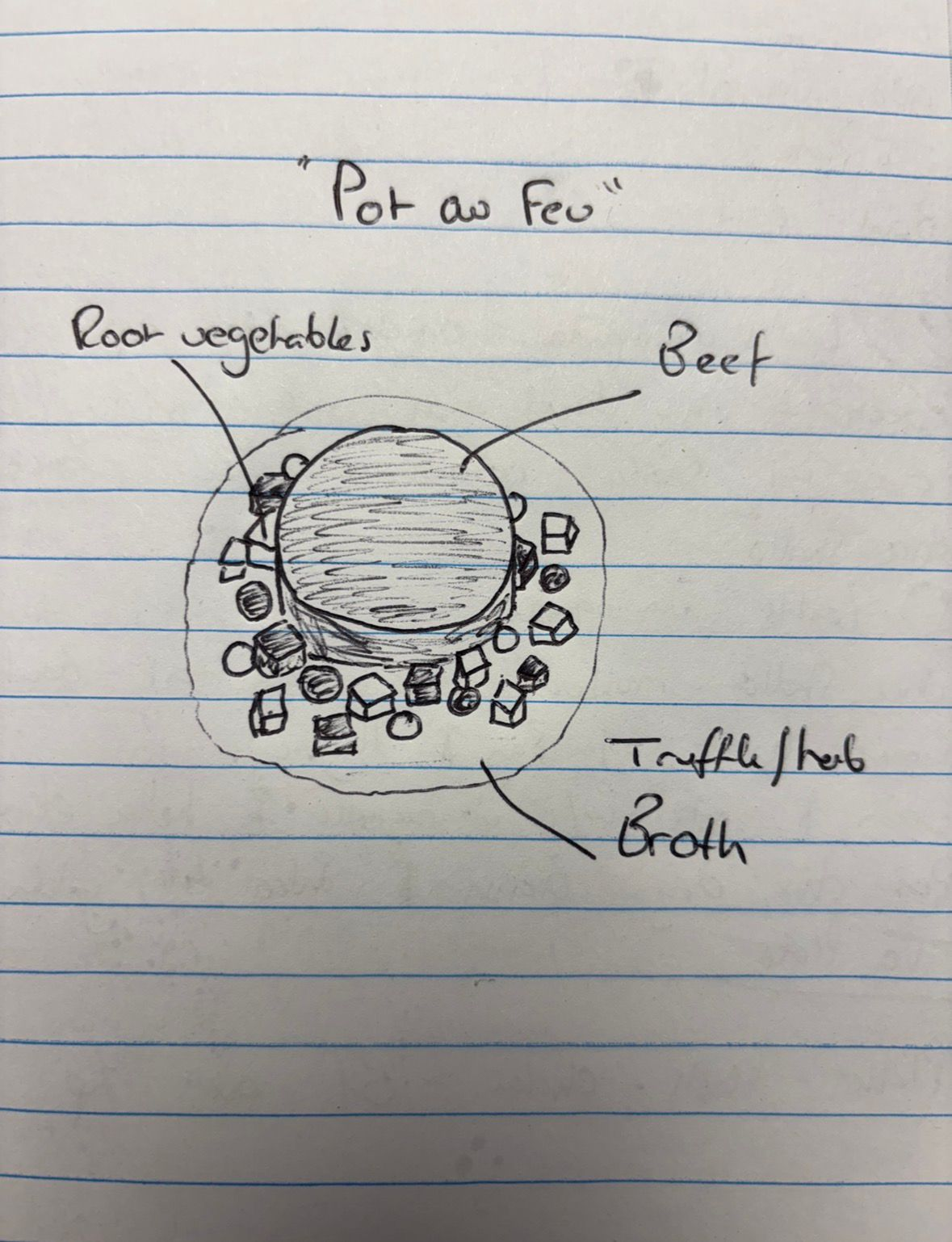
Something like a boeuf bourguignon, for example. It’s already a great dish, rich, comforting and built on solid foundations.
The job isn’t to reinvent it completely. It’s more about adjusting it slightly. Lightening it, refining it, treating each element with a bit more individual thought so it fits the way i cook. Keeping the identity of the dish but making it work in the context of a Bohémien menu.
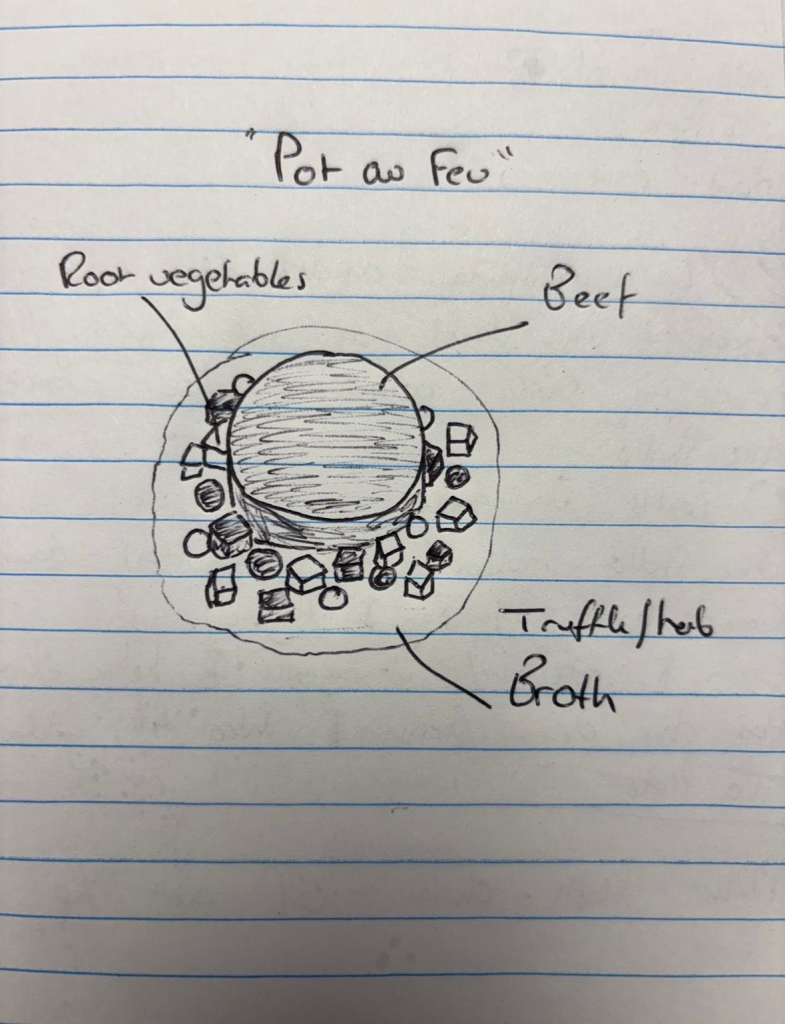
Once I’ve got a rough idea, I draw it.
I’m very visual in how I think, so I’ll sketch out the dish into its components, layout & how it might come together on the plate. As any of my former cooks will assent, I would tear a page out of my notebook and draw a dish instead of describing it in words. It’s just much easier for me this way.
There are notebooks all over the house filled with these. Some make it onto menus, most don’t. But it’s part of the process.
From there, it becomes more practical.
By that point, I usually have a good idea of how it’s going to taste. That comes from experience, working with the same ingredients over and over again, you start to understand how they behave.
So the focus shifts slightly.
How is it cooked?
How is it plated?
And most importantly, can it actually be served practically?
Running a supper club comes with its own constraints.
You can’t build dishes with seven or eight delicate components and expect them all to arrive at the table in perfect condition. Not without compromising temperature or quality.
So those limitations shape the dish as much as anything else.
I try to see that as a positive rather than a restriction. It forces you to simplify & to focus on what actually matters.
If something feels particularly new, I’ll test it.
Nothing overly formal, just cooking a few dishes for friends & seeing how they work outside of theory.
Not just how they taste but how they function. Timing, plating, flow, the things that don’t always show themselves until you actually cook it properly.
It’s also worth pointing out that this is very little for the sake of how a dish looks. I personally put a lot less importance on the visual aspect of food than what I see from most chefs, I’m thinking a lot more about how someone will eat this food.
A good example of this is a recent dinner we hosted at the cross inn.
The dish was grilled cod loin with saffron garlic aioli & a white bean & morteau sausage fricassee.
The aioli sits at the base of the bowl, then the cod & then the fricassee is poured over. Now I could swipe the aioli around the dish, I could slice the cod into pieces & I could deconstruct the bean fricassee into its component parts. But by plating the dish in this way I know that when you eat it you will get a little of everything together (which is or at least in my mind should be the point of any combination of flavours) & crucially the dish will stay hot.
If that’s the trade off for not having food that looks like a lot of the stuff you see on Instagram then that’s fine by me. You have to think of these things when you alone cook for a dining room or 20-30 people.
Because no matter how much you plan something, it’s only once you serve it. It’s important that you really understand the dish.
What works, what doesn’t, what needs adjusting.
Most dishes don’t make it that far. The ones that do tend to feel quite simple in the end.
But they rarely start that way.
At this point in my career I’m often finding myself taking away from food rather than adding. With good produce and sound techniques, less is most definitely more
If you’ve made it this far, thanks for tuning into another episode of “ the ramblings of a cook”
Tom
Chef & Owner, Bohémien